





Nifty 50 Falls 0.18%, Ending Eight-Year Muhurat Winning Streak
Key highlights
- Nifty 50 fell 43.95 points, or 0.18%, to close at 24,986.40.
- The Sensex declined 28.62 points, or 0.04%, to settle at 80,999.40.
- Nifty ended an eight-session Muhurat Trading winning run from 2018 through 2025.
- NSE breadth showed 2,716 advances against 736 declines during the session.
powered by IRIS
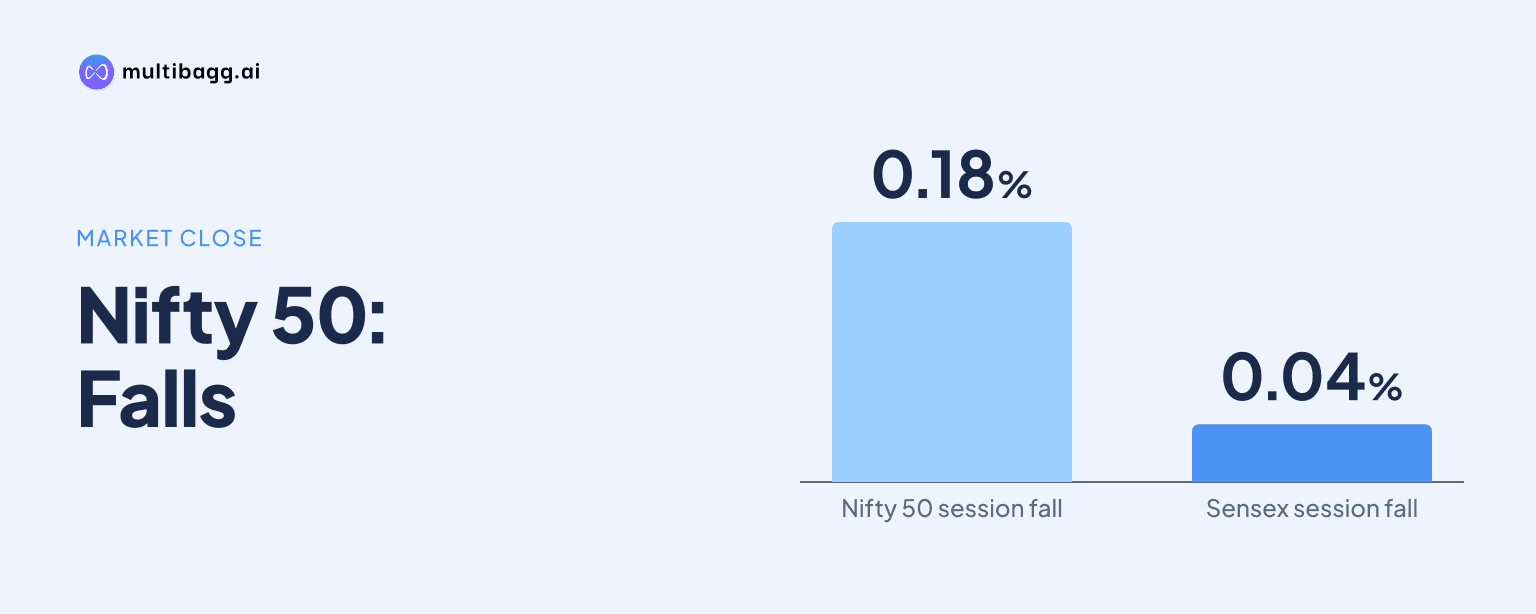
Nifty 50 fell 0.18% to 24,986.40 in the 2026 Muhurat Trading session, ending its eight-year run of Diwali-session gains from 2018 to 2025. The index gave up an early advance, slipped below 25,000 by the close and began Samvat 2083 on a marginally lower note alongside the Sensex.
Why did Nifty close lower in Muhurat Trading 2026?
Nifty closed lower because selling pressure erased the gains recorded early in the special Diwali session. It opened at 25,070 and reached an intraday high of 25,131.85, but ended 43.95 points lower at 24,986.40. The closing level was just below the closely watched 25,000 mark.
The decline came in a ceremonial session held on Sunday, November 8, marking the start of Samvat 2083, the new Hindu accounting year. Reports described the move as marginal, but it was notable because the index had finished each Muhurat Trading session higher from 2018 through 2025.
What were the Sensex and Nifty closing levels?
Nifty ended at 24,986.40, down 43.95 points or 0.18%, while the Sensex settled at 80,999.40, lower by 28.62 points or 0.04%. Both benchmark indices moved into negative territory after opening higher during the session.
The relatively small point losses nevertheless reversed the usual positive close associated with the recent Diwali sessions. Nifty's larger percentage decline compared with the Sensex also meant that the 25,000 threshold was lost by the close, despite the index having traded above that level earlier.
How does the 2026 Muhurat result compare with past sessions?
Nifty's 2026 decline was its first negative Muhurat Trading result since 2017. The index had posted gains in eight straight Diwali sessions between 2018 and 2025, creating the winning run that ended on November 8.
The previous weaker Muhurat session was held on October 19, 2017, when Nifty fell 0.63% and the Sensex declined about 0.60%. Across the 2016 to 2026 period, both indices gained in eight of the 11 Muhurat sessions and declined on three occasions. The 2017 session remained the weakest of that stretch for Nifty.
The record also puts the latest move in perspective. October 2022 was the strongest Muhurat session in the cited decade, with Nifty gaining 0.88%. In the prior year's session, the index had edged up 0.10% to 25,868.60, showing that not every positive Diwali close produced a large move.
Got a follow-up? Ask IRIS
What did market breadth show during the special session?
Market breadth remained positive even as Nifty and the Sensex finished lower. On the NSE, 2,716 stocks advanced against 736 declines, while the BSE recorded 3,253 advances and 937 declines.
That breadth data indicates that a larger number of listed shares rose than fell during the session, despite the two benchmark indices closing in the red. The contrast reflects the narrow nature of the benchmark decline described in the available reports and separates index performance from the broader count of advancing stocks.
The market's move also interrupted a seven-session winning streak for the benchmark indices mentioned in reports. For the new Samvat year, the immediate starting point is therefore a modest benchmark loss, an early intraday high above 25,000 for Nifty, and broadly positive advancing-versus-declining stock counts.
Conclusion
Nifty's 0.18% fall to 24,986.40 ended an eight-year run of positive Muhurat Trading outcomes and marked the first red Diwali session for the benchmark since 2017. The Sensex also closed marginally lower, although market breadth on both exchanges was positive, with advances outnumbering declines.
The next reference point is whether Nifty can regain and hold the 25,000 level after closing below it in the special session. Investors will also watch whether the positive breadth seen on the NSE and BSE carries into regular trading as Samvat 2083 begins.