





Sarda Energy says freight surge may squeeze steel margins
Key highlights
- Sarda Energy said South African coal freight rose to US$36-US$38 from a usual US$18-US$22 for a 50,000-ton vessel.
- Management said flat-steel prices were close to Rs 75,000-Rs 77,000, while some Mumbai long-product prices were close to Rs 54,000.
- Sarda Energy said captive coal mines meet part of its coal requirement, providing partial insulation from external coal costs.
- Management estimated that one 300-megawatt unit shutdown reduced quarterly revenue by about Rs 130 crore-Rs 140 crore.
powered by IRIS
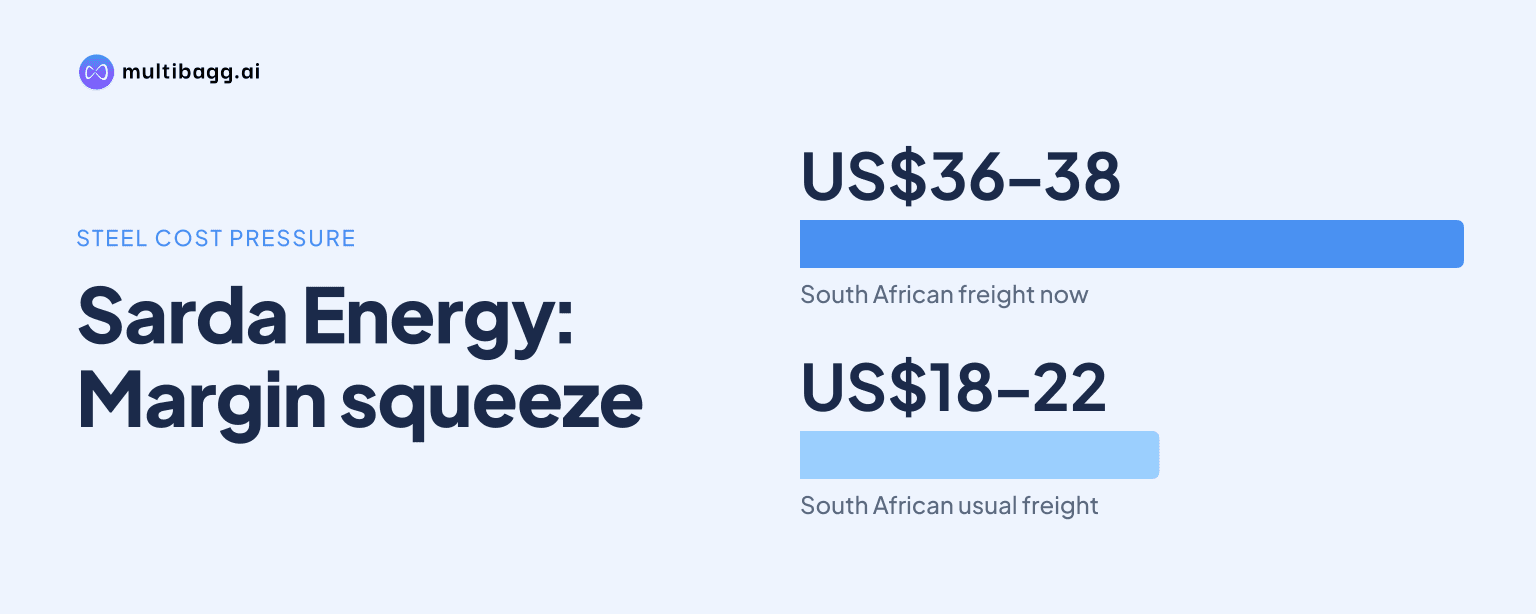
Sarda Energy said in its H1 FY27 earnings call that bulk freight for imported South African coal had climbed to US$36-US$38 from a usual US$18-US$22 for a 50,000-ton vessel, a rise that management said would create raw-material pressure for steel even as demand and realizations remained supportive.
Know Sarda Energy & Minerals inside out
Results, valuation, peers and who's buying, in one view.
Why has Sarda Energy’s imported coal freight risen?
Sarda Energy attributed the rise in imported-coal freight to high crude prices, which management described as a severe logistics-cost issue. Freight for South African coal was close to US$36-US$38, compared with the usual US$18-US$22 for a 50,000-ton vessel, making coal more expensive in steel production.
The quoted freight range shows a substantial change from normal levels: the low end of the current range was US$14 above the high end of the usual range, while the high end was US$20 above the low end of the usual range. Sarda Energy did not disclose the volume of coal imported from South Africa or state a cost increase per tonne of steel.
Management said the next quarter was difficult to predict because logistics costs were linked partly to crude prices and to whether tensions in West Asia eased. It did not offer a freight forecast or specify when current bulk-freight rates might return towards the usual US$18-US$22 range.
How could coal costs affect Sarda Energy’s steel margins?
Higher coal and freight costs could squeeze Sarda Energy’s steel margins because management said imported coal had become more expensive for steel production. It also said Australian coking coal had become very expensive during a period when flooding can affect mines and when December-January prices are typically high.
Domestic supply conditions added to the raw-material pressure. Sarda Energy said heavy monsoon flooding had affected mining facilities in India, pushing much mine production capacity to its lowest phase and raising raw-material prices in the country.
Pankaj Sarda said the domestic disruption should ease in the coming two to three months. That is management’s expectation rather than a disclosed cost target, and the call did not quantify how much of Sarda Energy’s steel raw-material requirement is exposed to Indian mines, Australian coking coal or South African imports.
Can higher steel prices offset Sarda Energy’s cost inflation?
Higher steel prices can partly offset Sarda Energy’s cost inflation, but management said the size of the raw-material squeeze would need assessment over coming quarters. Manish Sarda said flat-steel prices were close to Rs 75,000-Rs 77,000, while long-product prices in some Mumbai locations were close to Rs 54,000.
Sarda Energy described the overall steel market as buoyant, with flat products more buoyant than long products. Management said it hoped steel would remain strong and realizations would stay decent in the coming quarter, contrasting with the higher coal, coking-coal and freight costs it identified.
The company’s steel output can vary with the relative economics of power sales. Management said billet and wire production may be lower when it can sell power at remunerative prices, while billet and wire output may be higher if power realizations return to normal levels.
That mechanism allows Sarda Energy to choose between market power sales and further steel processing, but it does not eliminate steel’s exposure to coal costs. Management did not provide a margin target for billets, wire rods or any other steel product for H2 FY27.
Got a follow-up? Ask IRIS
How much protection do Sarda Energy’s captive coal mines provide?
Sarda Energy said captive coal mines meet part of its coal requirement, leaving it somewhat insulated from imported-coal freight and external raw-material prices. Management did not disclose the percentage of total coal needs supplied by captive mines, so the extent of that insulation cannot be calculated from the call.
Sarda Energy also said it was continuously looking for mines that could add raw-material security to its ferro-alloys operations in Raipur and Visakhapatnam. Management identified Maharashtra and Madhya Pradesh as regions closer to Raipur, and Andhra and Orissa as areas closer to its Andhra plant.
The company said it was also looking at international manganese opportunities. It did not disclose acquisition costs, expected production, a timetable or an output target for additional mines, and said it would not be prudent to comment on the costs of one recently acquired operating mine before assessing conditions on the ground.
What should readers watch in H2 FY27?
Readers should watch whether mine flooding eases within the two to three months cited by management and whether bulk freight falls from the current US$36-US$38 range. A reduction in domestic mining disruption or in crude-linked shipping costs could ease raw-material pressure, while continued disruption would keep the cost issue unresolved.
The H2 FY27 outlook also includes an important power-market offset. Management expects thermal profitability to be substantially higher in the second half because of improved market conditions and higher generation, although it expects hydropower profitability to be lower because of seasonal conditions.
Thermal power realization was about Rs 5.30 in the quarter, while hydropower realization was above Rs 6. Sarda Energy had tied up 60% of its saleable thermal-power capacity, and management said all hydro projects other than Sikkim were tied up.
Power availability may also improve following a maintenance interruption. Management estimated that the shutdown of one 300-megawatt unit reduced quarterly revenue by about Rs 130 crore-Rs 140 crore, based on an assumed 25 crore units of generation from one unit in one quarter, and said no thermal-power shutdown was foreseen in the next half of the current year.
Conclusion
Sarda Energy faces opposing forces in H2 FY27: steel demand and prices were described as buoyant, with flat steel near Rs 75,000-Rs 77,000, while South African coal freight rose to US$36-US$38 and coking-coal costs also increased. Captive mines provide partial protection, but management did not quantify their share of coal supply or the resulting effect on steel profitability.
The next markers are management’s expected two-to-three-month easing of domestic mine disruption, the movement in crude-linked bulk freight and Australian coking-coal conditions during December-January. Sarda Energy also expects higher thermal generation and profitability in the second half after the 300-megawatt unit shutdown, but management gave no FY27 earnings guidance.